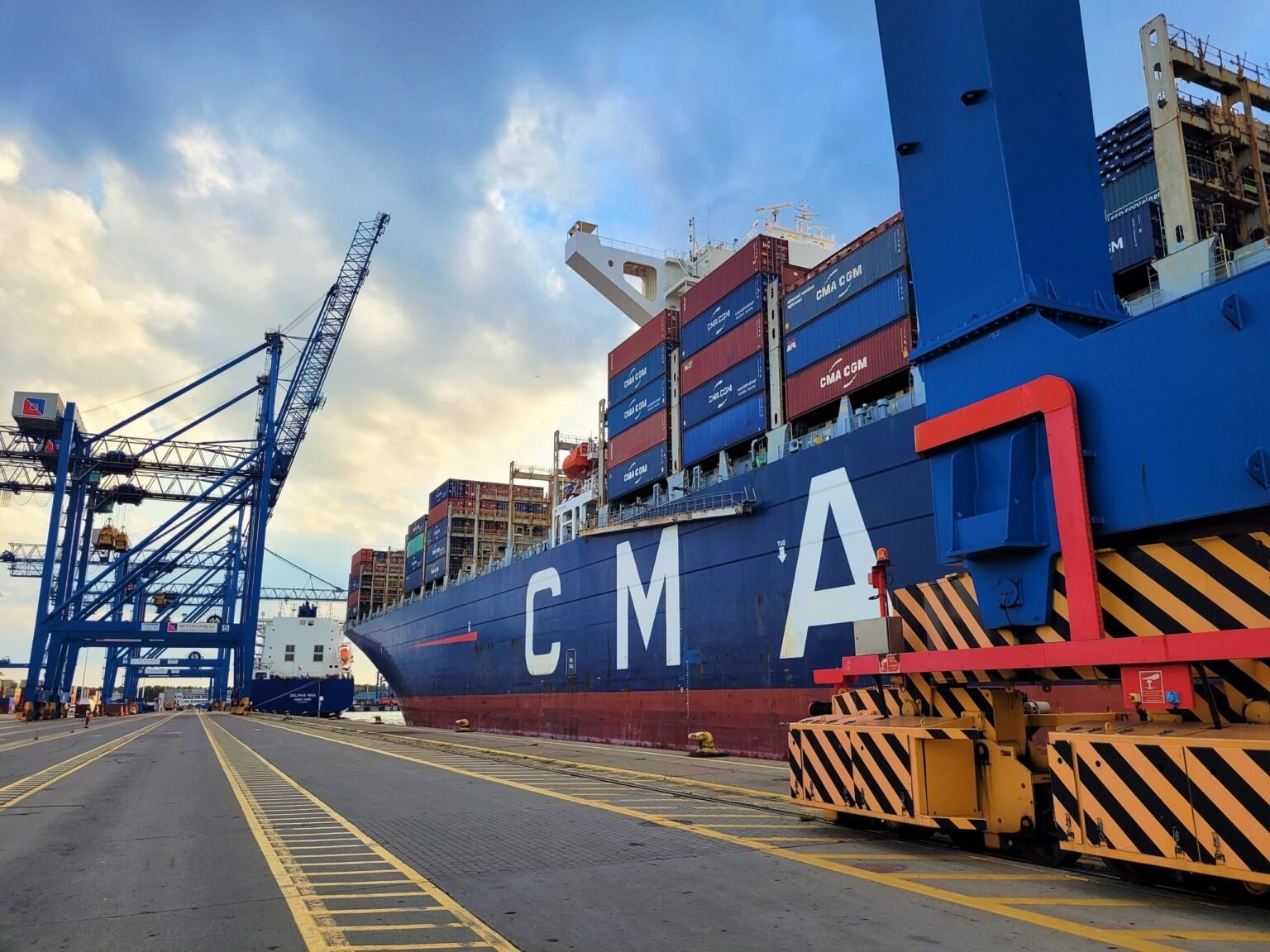
French ocean carrier CMA CGM has delayed a critical U.S. surcharge implementation, pairing it with two related charges later this month. Initially set for January 1, the peak-season surcharge of $1,500 per unit on cargo from the Indian subcontinent, Middle East Gulf region, Red Sea, and Egypt to the U.S. East and Gulf coasts has been postponed to January 15.
This surcharge postponement follows CMA CGM’s notable operations in the Red Sea despite security concerns. Unlike other carriers rerouting vessels around the Horn of Africa due to Yemen-based Houthi attacks, CMA CGM maintained Red Sea services, avoiding longer, costlier voyages to connect Asia, Europe, and the U.S. The carrier has not yet commented on this decision.
In addition, CMA CGM announced that effective January 18, it will impose a peak-season surcharge on containers moving from Mediterranean ports to U.S. East and Gulf Coast ports. These surcharges are set at $1,300 for 20-foot containers, $2,000 for 40-foot containers, and $2,500 for 45-foot dry containers. Refrigerated containers will face $1,300 for 20-foot units and $2,500 for 40- and 45-foot units.
The Mediterranean surcharges will apply to cargo from ports such as Marseilles-Fos in France, Italy, Portugal, Algeciras, Valencia, Barcelona, Sagunto, Vigo in Spain, and Morocco. Exceptions include out-of-gauge oversize freight and break-bulk shipments requiring pre-payment.
The postponement aligns with FreightWaves’ reports of upcoming longshore contract negotiations. Talks between the International Longshoremen’s Association (ILA) and United States Maritime Alliance (USMX) are expected to resume soon. Informal discussions have reportedly occurred since the ILA suspended talks in November, but no official confirmation has been made.
Meanwhile, CMA CGM’s new Panama Canal Transit surcharge, effective January 1, 2025, reflects rising costs tied to the Panama Canal Authority’s Long-Term Slot Allocation (LoTSA) system. This surcharge is $150 per twenty-foot equivalent unit for cargo moving from the South America west coast to the U.S. and Canada. Identical charges apply to cargo moving between South America west coast-South America east coast and South America west coast-Guyana North Brazil routes, effective January 5.
CMA CGM cited LoTSA’s impact on canal crossing reservations as the reason behind increased operational costs. As negotiations and surcharges unfold, shippers and stakeholders must navigate these adjustments amidst evolving maritime trade conditions.